
# Roofing Sales Training: What You Actually Learn
You have seen the income claims on roofing sales job posts and you are skeptical, and you should be. What almost none of them tell you is what the roofing sales training actually consists of — what you will be doing in week one, what you have to memorize, and how long it takes before you are standing in front of a homeowner on your own. That gap is why good people talk themselves out of a career that would have worked for them.
Roofing sales training at Flagstone Roofing has two halves: in-field training where you shadow a working rep on real properties, and in-office training through our 6 Figure Blueprint university. You learn the roof itself, the insurance process, and the conversation — in that order, because you cannot sell what you cannot inspect.
Key Takeaways
- You learn the product first. Reps who can read a roof outsell reps who only memorized a script.
- In-field training means real properties with a working rep, not role-play in a conference room.
- The 6 Figure Blueprint is our in-house university, and it is real training, not a signup fee.
- There is no “paid training” gimmick at Flagstone and we do not charge you to learn.
- No roofing background is required. Most of our strongest reps came from other industries.
What do you learn first in roofing sales training?
You learn the roof. Before you ever run an appointment alone, you learn to identify hail bruising, wind creasing, worn flashing, pipe boot failure, and the difference between age-related wear and storm damage. This comes first for a practical reason: a homeowner’s first real question is always some version of “is my roof actually damaged?” A rep who can answer that accurately, on the spot, has already earned the conversation.
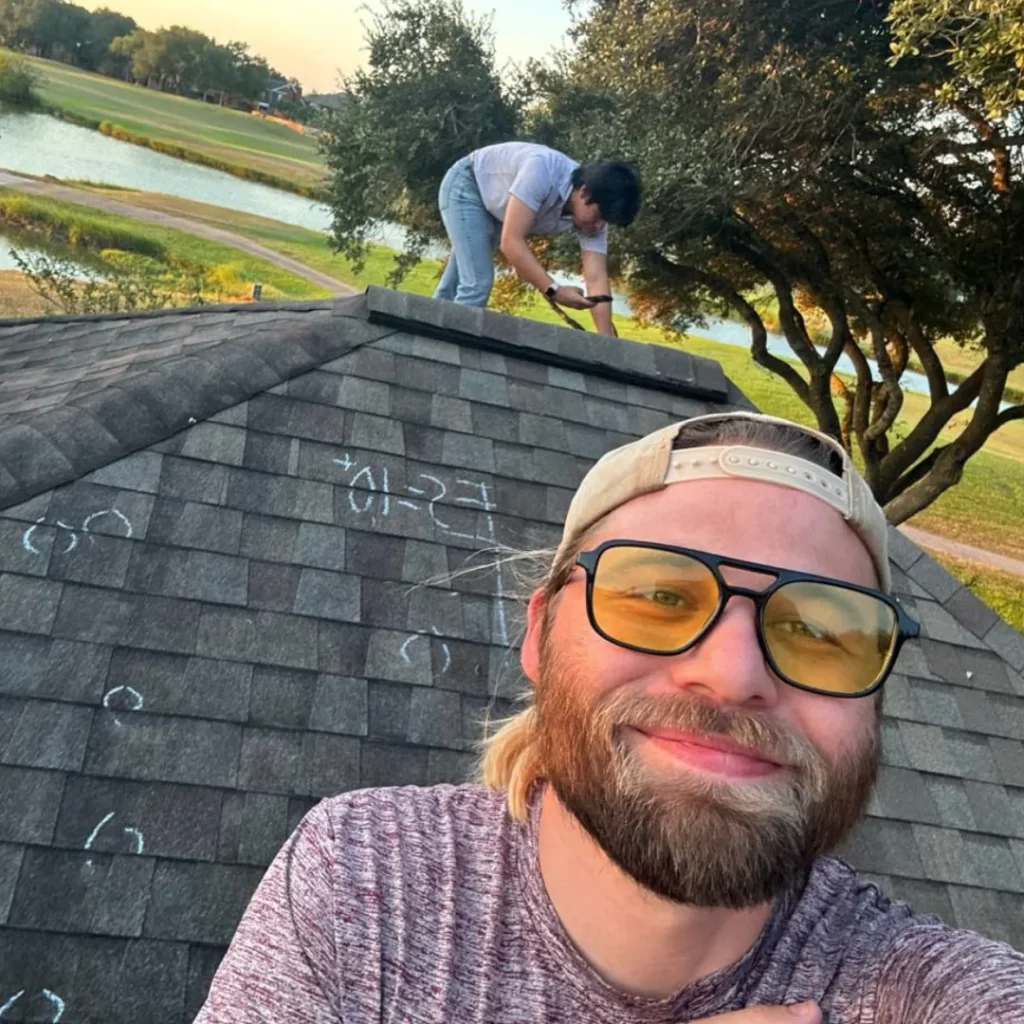
This part is hands-on. You are on roofs and around roofs, with someone who has done it for years, looking at real damage on real houses rather than photographs in a slide deck.
What does in-field training actually look like?
You shadow a working sales rep through their normal day. That means door knocks, scheduled inspections, roof climbs, adjuster meetings, and follow-up calls — the whole cycle, not a curated version of it. You watch how the conversation opens, where homeowners push back, and how a rep handles the answer “I need to talk to my spouse.”
Then it inverts. You start running parts of the appointment while your trainer observes, and the balance shifts until you are running the whole thing and they are just there. Most people find this the fastest part of the learning curve, because doing it once teaches more than hearing about it ten times.
What is the 6 Figure Blueprint?
The 6 Figure Blueprint is our in-office training university. It covers the parts of the job that are not visible from the roof: how insurance claims move, what an adjuster is looking for, how to document damage so a claim holds up, how to structure your week, and how to manage a pipeline so your income is not a rollercoaster.
It is worth being blunt about one thing. Some roofing companies advertise “paid training” that turns out to be a stipend against future commission, or worse, a program you pay to join. We do not do that. The 6 Figure Blueprint is training we provide because trained reps make the company money. You are never charged to learn this job.
How long before you are running your own appointments?
It varies with background and effort, but the structure is the same for everyone:
| Stage | What you are doing | Who is with you |
|---|---|---|
| Product and roof basics | Learning damage types, materials, and the inspection itself | Trainer, hands-on |
| Shadowing | Watching full appointments end to end | Working sales rep |
| Co-running | You run parts, trainer runs the rest | Working sales rep |
| Solo with support | Your own appointments, help a phone call away | Sales manager |
| Independent | Your own pipeline and schedule | Ongoing coaching |
Nobody gets pushed to the next stage on a calendar. You move when you are ready, because sending someone out early produces a bad experience for the homeowner and a discouraging one for the rep.
Do you need experience to start?
No. Most of our reps came from somewhere else entirely — restaurants, retail, the military, other trades, other sales jobs. What actually predicts success is a short list: you are comfortable talking to strangers, you can take a “no” without it ruining your afternoon, you follow up when you said you would, and you are not afraid of a ladder.
What does not predict success: a degree, a construction background, or having sold anything before. We teach the roofing. We cannot teach someone to want the work.
If you are weighing this against other options, our honest take on whether roofing sales is a good career covers the tradeoffs, and roofing jobs with no experience in Texas covers the starting point in more detail.
What does the job look like once training ends?
Training does not really end, it just changes shape. You keep getting coaching, and the market keeps changing — insurance carriers adjust their processes, material costs move, storm seasons differ. Reps who stay sharp treat the learning as permanent.
Day to day, the work is a mix of generating your own opportunities, inspecting roofs, meeting adjusters, and managing the homeowners already in your pipeline. Our breakdown of what a roofing sales rep actually does walks through a real day, and what to expect in a roofing sales interview covers the step before that.
For context on the industry itself, the U.S. Bureau of Labor Statistics publishes occupational data on roofers and construction trades, which is a useful outside reference on where the work is heading.
Why the training is structured this way
Flagstone Roofing has been operating in Texas for 30+ years. We are GAF Certified, BBB A+ rated, and we carry a lifetime workmanship warranty on our work. That reputation is built by reps who tell homeowners the truth, including when a roof does not need replacing.
That is a harder job than reading a script, and it needs real training rather than a pep talk and a territory map. It is also why the reps who stay tend to stay a long time — the work holds up, because what they are selling holds up.
Ready to see if this fits?
If you want a career where your income is not capped by a pay band, where you are trained properly, and where you are not charged for the privilege of learning, we are hiring Sales and Community Relations reps across Texas.
Book an interview with Flagstone Roofing and we will walk you through the training, the territory, and the honest version of what the first ninety days look like.
Frequently Asked Questions
Do I need roofing experience to start roofing sales training?
No. Most of our reps came from other industries entirely. We teach the roofing side from the ground up. What matters is that you are comfortable talking to strangers, follow up reliably, and are not afraid of a ladder.
Is the training paid?
We do not run a paid training gimmick, and we never charge you to learn. The 6 Figure Blueprint and in-field training are provided because trained reps make the company money. Compensation details are covered directly in your interview.
How long does roofing sales training take?
It depends on background and effort rather than a fixed calendar. You move from shadowing to co-running appointments to solo work when you are ready. Pushing someone out early creates a bad experience for the homeowner and the rep.
What is the 6 Figure Blueprint?
It is our in-office training university. It covers how insurance claims move, what adjusters look for, how to document damage properly, and how to manage a pipeline so your income is steady rather than unpredictable.
Will I be on roofs during training?
Yes. Roof climbs and hands-on damage identification are a core part of in-field training. You learn to tell hail bruising from age-related wear on real properties, not from slides.
What happens after training ends?
Coaching continues. Insurance carrier processes, material costs, and storm seasons all change, so the reps who do best treat learning as ongoing rather than a phase they graduated from.