
# Roofing Sales Rep Salary in Texas: What You Can Make
If you are looking at roofing as a career change, the roofing sales rep salary question is the one you actually want answered before anything else. Not the culture, not the truck, not the training. What does this job pay, how fast does it pay, and what separates the rep making a modest living from the rep buying a house in year two.
The short answer
Roofing sales in Texas is commission-driven, which means there is no single salary number and anyone who quotes you one is guessing. Income tracks three things: how many roofs you inspect, how many of those turn into signed jobs, and the size of those jobs. A rep who inspects consistently through storm season earns very differently from a rep who works when they feel like it. The uncapped part is real, and so is the fact that it cuts both ways.
Key Takeaways
- Roofing sales pay is commission-based and uncapped, so your effort sets the ceiling, not a pay band.
- Income is driven by inspection volume first, closing rate second, and job size third.
- Storm season in Texas creates income spikes that reps who plan for them ride and reps who do not, waste.
- Year one is a learning year for most people; year two is where the compounding shows up.
- Flagstone Roofing provides in-field and in-office training plus the 6 Figure Blueprint. There is no such thing here as paid training that is really a wage in disguise.
Why nobody can hand you one salary figure
A salaried job pays you for hours. Roofing sales pays you for outcomes. That difference is the whole reason the income range is wide, and it is why job boards that list a single average for this role are describing a distribution as if it were a number.
Two reps can work the same territory, for the same company, in the same month, and land in completely different places. Not because one has a secret, but because one knocked more doors, ran more inspections, and followed up on the ones that did not sign the first time.
Here is what actually moves the number.
| What drives income | What it means day to day | How much control you have |
|---|---|---|
| Inspections run per week | How many roofs you actually get on | Almost total |
| Close rate | How many inspections become signed jobs | High, and it improves fast with training |
| Job size | Full replacement versus a repair | Partial, driven by territory and storm activity |
| Follow-up discipline | Whether the “not right now” homeowners come back | Almost total |
| Season timing | Whether you are ready when a storm hits | Total, if you plan for it |
Notice that most of that column is in your hands. That is the honest pitch for this career, and it is also the warning.
What the first 90 days really look like
Nobody walks in and closes at a veteran rate. The first stretch is learning to read a roof, learning how insurance claims actually work in Texas, and learning to have a straightforward conversation with a homeowner who has already been knocked on four times this month.
1. Weeks 1 to 3. Riding along, learning damage identification, learning the claim sequence. You are absorbing, not producing.
2. Weeks 4 to 8. Running your own inspections with backup. First signed jobs usually land here. Confidence moves faster than skill at this stage.
3. Weeks 9 to 12. Enough volume to see your own patterns. This is the point where reps who track their numbers separate from reps who do not.
The reps who do well in month four are almost always the ones who treated months one through three as training rather than as a slow start.
Storm season and why timing matters so much
Texas weather does not distribute evenly. A single hail event across a metro can generate more qualified work in three weeks than the previous three months combined. Reps who are trained, licensed up, and already working a territory when that happens capture it. Reps who are still getting comfortable do not.
This is the practical reason to start before you feel ready rather than after. The learning curve is fixed in length. Where you are on it when the weather turns is not.
The parts of the job people underestimate
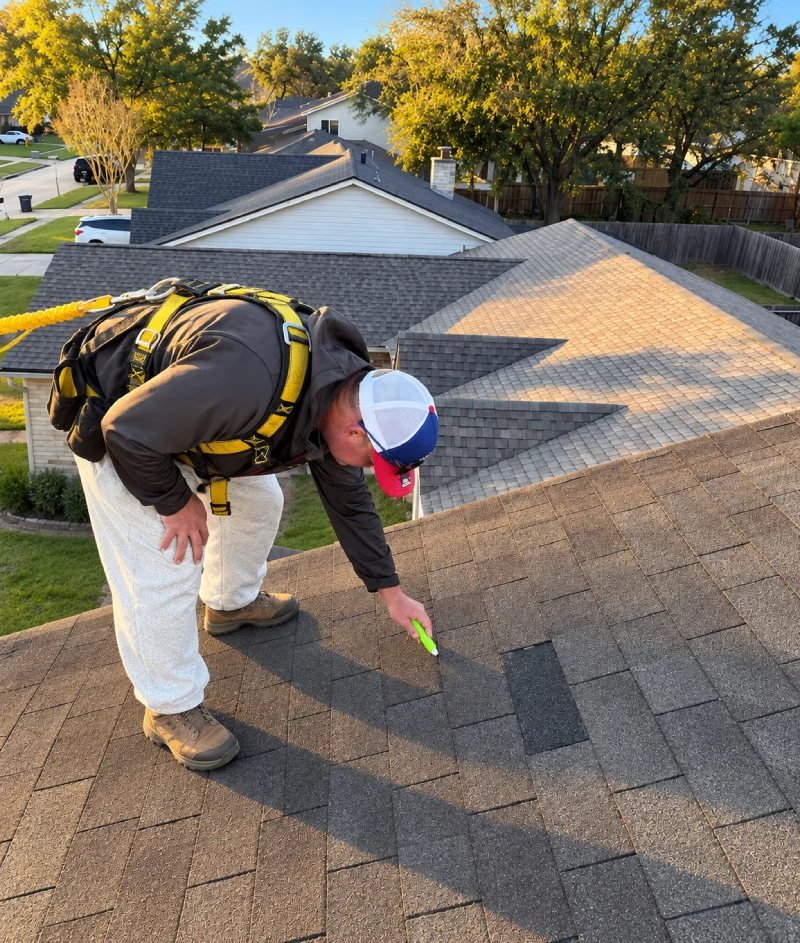
It is outdoor work. You will be on ladders and on roofs, in Texas heat, most days. That is not a downside for everyone, but it is real.
It is a documentation job as much as a sales job. Photographing damage properly, writing findings clearly, and handling a claim file correctly is a large share of the work. Reps who are sloppy here lose jobs at the adjuster stage that they had already earned at the front door.
Rejection is the volume you are managing. Most conversations end in no. The skill is not avoiding that, it is running enough conversations that the yes rate stops feeling random.
If you want the day-to-day picture in more detail, we wrote what a roofing sales rep actually does. If you are wondering whether the field suits you at all, is roofing sales a good career is the more honest read.
What you need before you start
Not much, and that surprises people.
- A driver’s license and reliable transportation.
- A willingness to be on roofs and outdoors in the heat.
- Enough financial runway to get through a learning curve without panicking.
- The ability to have a normal conversation with a stranger at their front door.
You do not need a construction background. You do not need a degree. Several of the strongest reps on the team came from restaurants, retail, and the trades. What they had in common was showing up on the days that were not fun. We cover the no-background path in roofing jobs with no experience in Texas.
How training works here
Flagstone Roofing runs in-field and in-office training, plus the 6 Figure Blueprint, which is the internal program that teaches the whole system rather than just a script. What we do not do is the fake paid training some companies advertise, where a small wage is dangled to get people in the door and then quietly disappears.
You are being trained to run a territory as an operator. That means damage identification, the Texas claim process end to end, adjuster meetings, and follow-up systems, not just how to open a conversation.
The company itself is a 30+ year Texas roofing contractor, GAF Certified and BBB A+, with 400+ five-star reviews across the metros we work. That matters to your income more than it sounds like it should. Reps at companies with a bad reputation spend half their energy overcoming it at the door. You will not be doing that.
Is this the right move for you?
It is, if you want your income tied to your output and you are willing to accept the volatility that comes with that. It is not, if you need a predictable number arriving on the same day every month regardless of what you did.
The people this works best for tend to be the ones who have been frustrated by a ceiling somewhere else. Someone who outperformed and got the same raise as everyone else. That frustration is exactly what an uncapped commission structure resolves.
The U.S. Bureau of Labor Statistics occupational outlook is a reasonable outside reference for how commission sales roles are structured generally, though it will not tell you anything specific about Texas storm work.
Next step
If you want the real numbers for your metro, the fastest way is a conversation. We will tell you what reps in your area are actually producing, what the ramp looks like, and what we expect from you in the first 90 days. No pressure, and no pitch about how anyone can do this, because not everyone can.
Book an interview with Flagstone Roofing and we will go through the territory, the training, and the compensation structure line by line.
Frequently Asked Questions
Do roofing sales reps get a base salary in Texas?
Roofing sales is commission-driven, which is what makes the income uncapped. At Flagstone Roofing you get in-field and in-office training plus the 6 Figure Blueprint rather than a small wage dressed up as paid training that quietly disappears after a few weeks.
How long before a new roofing sales rep starts earning?
Most reps sign their first jobs somewhere in weeks four to eight, once they are running their own inspections with backup. Months one through three are best treated as a training investment. Month four is usually where the pattern becomes visible.
Do I need construction experience to sell roofing?
No. Several of the strongest reps came from restaurants, retail and unrelated trades. What matters is a driver’s license, willingness to be on roofs in Texas heat, and the ability to have a normal conversation at a stranger’s front door.
How does storm season affect roofing sales income?
Heavily. A single hail event across a metro can generate more qualified work in three weeks than the previous three months. Reps who are already trained and working a territory when it hits capture that. Reps still ramping up largely miss it.
What is the hardest part of roofing sales that people underestimate?
The documentation. Photographing damage properly, writing clear findings and handling a claim file correctly is a large share of the job. Reps who are sloppy there lose jobs at the adjuster stage that they had already won at the front door.
Is roofing sales a long-term career or a seasonal job?
It is a career for the people who treat it like one. Texas has storm activity year-round and repair, maintenance and replacement work between events. The reps who build a territory and a follow-up system have income across the calendar, not just after hail.